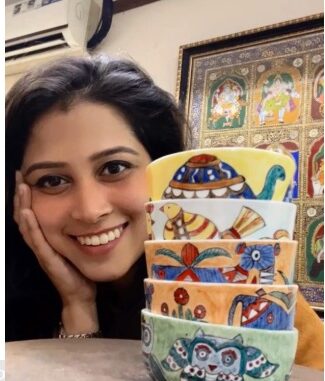
Smriti Sangal is based in New Jersey serving communities in NYC, Connecticut, NY, NJ & Philadelphia while also offering weekly online classes and workshops.
Influenced by ideas drawn from chaos theory, Sangal’s practice interprets the countless networks—physical, emotional, and imagined—that continuously construct and deconstruct our surroundings. Drawn to complexity and intricacy, she works across varied mediums with a strong emphasis on conscious hand-making and the slow evolution of form. Balancing between the literal and the abstract, she seeks to physically recreate a sense of order, disruption, and interconnection, inviting viewers into layered, immersive environments that evoke curiosity, anticipation, and a quiet sense of mystery.
Alongside her studio practice, Sangal is also an experienced art educator and the founder of Culture Chauraha (“Culture Crossroads”), a New Delhi– and New Jersey–based art studio. This engagement with community and learning continues to inform her artistic sensibility, reinforcing her belief in creativity as a shared, evolving experience.
“I’m very intentional about creating a space that feels welcoming and low-pressure, where questions are encouraged and personal stories can naturally enter the work. Confidence often grows through small moments—finishing a piece you didn’t think you could or discovering something unexpected while experimenting. Whether we’re working with water colour, acrylics, printmaking, or clay, my hope is that people leave feeling not just more skilled, but more open, playful, and trusting of their own creative voice, confident to try out the medium on their own at home. Equally important to my inspiration is the energy of community spaces. From neighbourhood workshops in India to libraries and art centres in the U.S., I’m continually moved by what happens when people of different ages and backgrounds come together to make. Teaching, in this way, becomes a source of inspiration in itself—each class bringing new questions, perspectives, and visual possibilities that quietly feed back into my own practice.
On her work
Across all my projects, my aim is to keep art approachable, tactile, and rooted in everyday materials and stories. Whether in a formal classroom, a library program, or an online setting, my focus is always on process: slowing down, paying attention, and finding joy in the act of making. I love seeing how small gestures of creativity—mixing colors, shaping clay, or layering textures—can spark curiosity, confidence, and a sense of wonder in participants of all ages.
Equally important to me is building connections between communities—linking India and the U.S., children and adults, beginners and practicing artists—through shared creative experiences. Each workshop is a step toward that ongoing conversation, creating moments of collaboration, dialogue, and discovery. Ultimately, I hope my work encourages people not only to explore their own creativity but also to see the value of making, sharing, and connecting through art.
On her family
Family support has been central to my journey—my parents encouraged me to pursue an arts education and backed the decision to co-found an independent studio in New Delhi. I feel deeply grateful, knowing that in many South Asian families, such a path might not be understood or even considered. For me, it was not only understood but embraced wholeheartedly. Their belief in the value of creative work gave me the confidence to take risks, experiment with new formats, and remain committed to an art-centered life.
Re-establishing a career in a new country brought its own set of challenges, and my husband has been an incredible source of support through that transition. He helped me let go of old patterns that no longer served me, patiently held space during phases of uncertainty, and created the stability at home that allowed me to focus on teaching and my studio practice—while also managing his own unique set of struggles. That grounding has, in turn, made me more present, generous, and engaged—both in the classroom and in collaborative projects—allowing me to show up fully for my students, my work, and the creative community I’m part of.
On looking ahead
Everyday walks, travel, and careful observation of urban and natural environments often find their way into my sketchbooks and inspire future projects. I am also deeply interested in psychology and human relationships, exploring how emotions, interactions, and personal narratives can inform both my work and the experiences I create in workshops. Looking ahead, I plan to continue developing workshops that blend fine art techniques with accessible, everyday materials, expanding both in-person and online offerings across diverse institutions.
Read the full story that first appeared in Seema Magazine here:

Leave a Reply