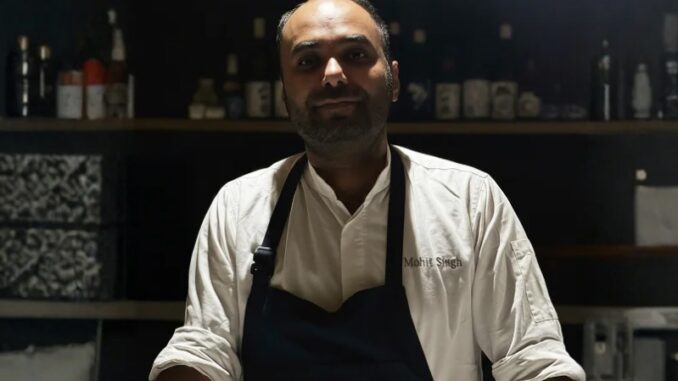
Chef Mohit Singh, the culinary mind behind Otoki, Colaba’s newest modern Izakaya-style dining destination.
With a career shaped by global fine-dining kitchens and Michelin-starred techniques, Chef Mohit brings a fresh yet authentic perspective to Japanese cuisine in Mumbai. At Otoki, he’s crafted a menu that’s rooted in traditional izakaya culture, celebrating simplicity, seasonality, and sociability while adding subtle contemporary touches that create a truly immersive dining experience.
Some excerpts from a conversation:
My decision to become a chef evolved gradually, driven by a genuine love for cooking and an increasing fascination with how food works at a deeper level. What initially attracted me was the creative aspect, but over time I realised that cooking is equally rooted in logic, structure, and science. Understanding heat, texture, seasoning and timing gave me a sense of purpose and clarity, and I found the kitchen to be a space where discipline and creativity coexist naturally.
As I progressed in my training and early professional years, Japanese cuisine consistently stood out to me. What captivated me was its precision and honesty. Japanese cooking does not rely on heavy sauces or excessive seasoning; instead, it demands accuracy. Knife work, temperature control, and ingredient handling are non-negotiable. There is no room to mask mistakes, which makes the cuisine both challenging and deeply rewarding.
Another aspect that drew me toward Japanese cuisine was its philosophical depth. Concepts like seasonality, balance, and respect for nature are central to washoku. Food is not created to impress, but to honour the ingredient and the moment. This restraint resonated strongly with my personal approach to cooking. I was inspired by how even the simplest dish, when executed correctly, can be profound.
Japanese kitchens also operate with an unmatched level of discipline and hierarchy. Observing how years are devoted to mastering a single technique reinforced my belief in long-term learning rather than quick success. This mindset aligned with my own values and made Japanese cuisine a natural focus for my career.
Some of the most meaningful milestones in my career are closely tied to personal growth rather than titles. Learning the Japanese language was one such milestone, as it allowed me to integrate deeply into Japanese culture and kitchens. It gave me access to knowledge that goes beyond recipes and into philosophy and tradition.
Obtaining my puffer fish licence in Japan was another significant achievement. It represents trust, responsibility, and technical competence within Japanese culinary tradition. The process reinforced the importance of precision and discipline, where even the smallest error is unacceptable.
These experiences collectively helped define my professional identity and approach to leadership.
In today’s interconnected world, being a Global Indian also means acting as a cultural bridge. Through my work at Otoki, I aim to present Japanese cuisine with honesty while applying the sensitivity and adaptability I have developed as an Indian chef. It is about respecting the cuisine you represent while understanding the audience you serve.
One of the most significant challenges I have faced has been introducing authentic Japanese cuisine in a market where Japanese food is often perceived through the lens of Nikkei or fusion interpretations. While these styles have their place, they can blur the understanding of traditional washoku, which is subtle, restrained, and deeply ingredient driven. Guests often expect bold, spicy, or sharp flavours, whereas authentic Japanese cuisine focuses on balance, umami, and natural taste.
Building acceptance for this approach required patience and consistency. Rather than altering our food to match expectations, we focused on educating our guests through the dining experience itself. Every dish at Otoki is designed to highlight the role of each ingredient and how it contributes to overall harmony. Over time, guests begin to appreciate the depth that comes from simplicity.
Another challenge has been sourcing ingredients that meet Japanese standards while working within India’s supply ecosystem. This required building strong supplier relationships and adapting responsibly without compromising authenticity. Overcoming these challenges has reinforced my belief that clarity of vision and long-term commitment are essential to building credibility.
Read the full story that first appeared in The Global Indian here:

Leave a Reply