
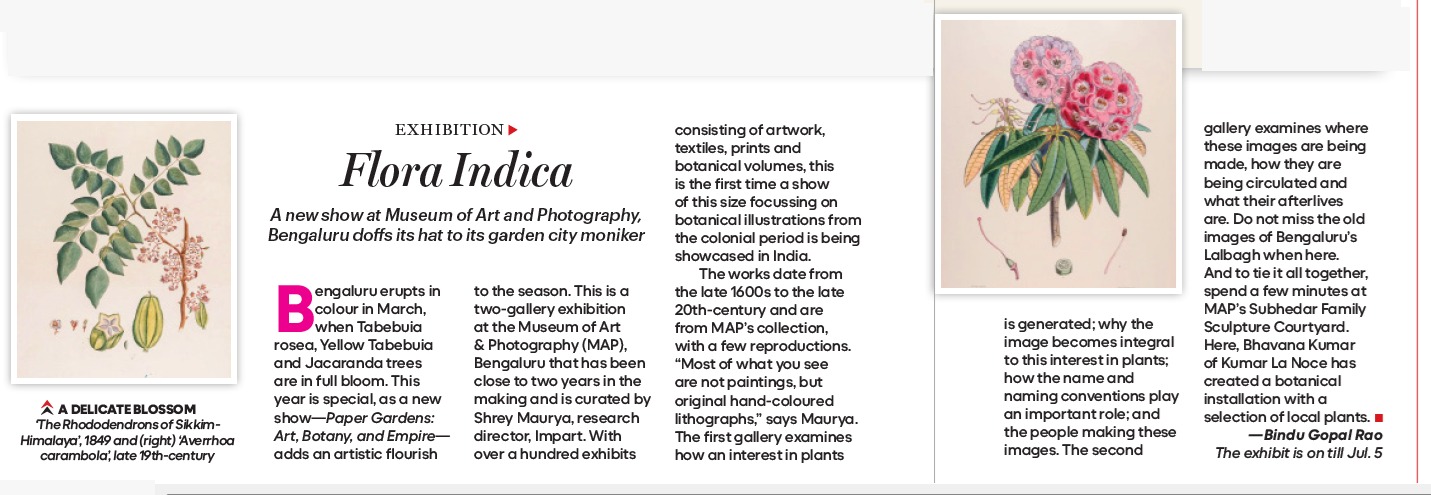
The exhibition “Paper Gardens” explores the history of botanical illustration in the Indian subcontinent between the 18th and 19th centuries, a period when scientific interest in plants expanded rapidly. Many of the works on display are lithographs, copperplate engravings, and prints rather than hand-colored originals. Among the rare items shown are folios from the Hortus Malabaricus, a major 17th-century botanical compendium documenting around 700 plants from the Malabar coast, and Thesaurus Zeylanicus, an early study of plants from Sri Lanka.
During this time, botanical exploration in India grew alongside colonial expansion and global scientific curiosity. What initially began as a search for commercially useful plants gradually evolved into scientific botany, supported by systematic observation and classification. European botanists working in India relied heavily on local knowledge, including indigenous plant collectors, gardeners, physicians, and artists who helped identify plants and record their uses.
Botanical illustrations became crucial because they could capture details that written descriptions or preserved specimens could not. An image could show color, scale, structure, and different stages of a plant’s life cycle, making it an essential scientific tool. These illustrations often condensed multiple observations into a single, highly detailed image.
However, despite their importance, the Indian artists who created these works were rarely credited. Many of them were trained in traditions such as Mughal miniatures, kalamkari, or decorative painting, and they adapted their skills to produce highly accurate botanical images required by European science.
The exhibition also highlights how classification and naming of plants were tied to colonial power. European scientists adopted the binomial naming system introduced by Carl Linnaeus, often renaming plants that already had local names. Many species were named after British administrators, botanists, or patrons, reflecting the politics of empire. Only rarely were local contributors acknowledged.
Overall, the exhibition shows how botanical illustration in colonial India was the result of collaboration between European scientific ambition and indigenous knowledge and artistry. While these images served scientific purposes, they are also remarkable works of art, revealing a largely forgotten history where art, science, and empire intersected.
Read the full story that first appeared in India Today here:

Leave a Reply